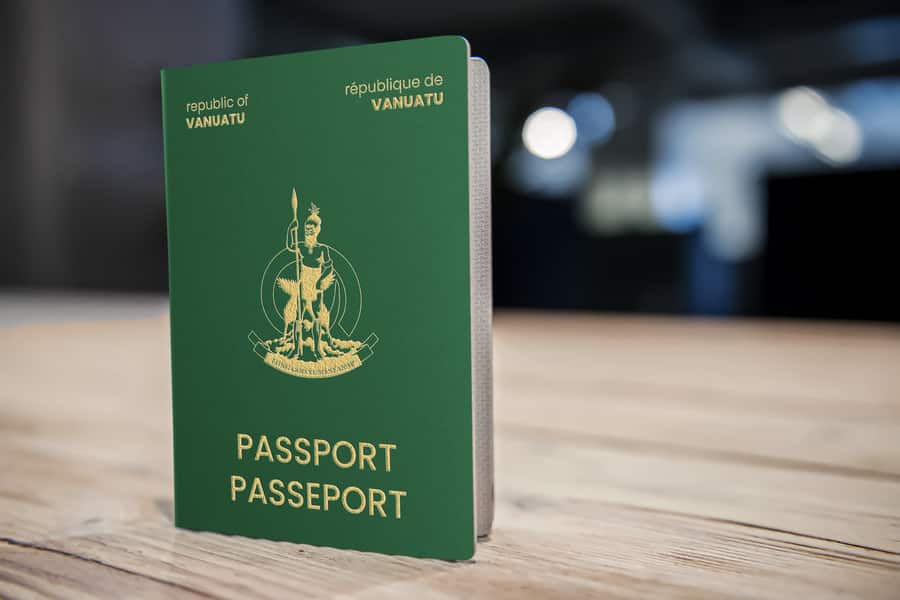
A California entrepreneur deposited $130,000 in January 2026 to secure a second passport through Vanuatu's Development Support Programme. Within 90 days, she had taken the Oath of Allegiance online—without ever setting foot outside the United States—and received her Vanuatu passport in her mailbox. No residency requirement, no extended waiting period, no physical presence in the South Pacific.
US citizens can obtain Vanuatu citizenship through the Development Support Programme (DSP), a citizenship-by-investment program requiring a minimum $130,000 donation for a single applicant. The entire process runs three to four months and demands zero days in Vanuatu. Dual citizenship is permitted; Americans keep their US nationality and hold both passports simultaneously.
Development Support Programme (DSP) – the official citizenship-by-investment framework established under Vanuatu's Domestic Legislation, administered by the Vanuatu Citizenship Commission and the Central Bank of Vanuatu, through which foreign nationals may acquire Vanuatu citizenship by making a qualifying financial contribution to the government.
Key Takeaways
- $130,000 minimum donation for a single US applicant through the DSP
- 3–4 months total from application to passport in hand
- No residency requirement—the entire process happens remotely from the United States
- Preliminary approval and due diligence: 2 weeks
- 75% of the donation due to the Central Bank within 90 days of Citizenship Commission approval
- US citizens retain American citizenship; no conflict with dual-nationality policy
What is Vanuatu's Citizenship-by-Investment Program and How Does It Work?
Vanuatu's citizenship pathway operates through the Development Support Programme, a national program governed by the Republic of Vanuatu. The Vanuatu Citizenship Commission evaluates applications. The Central Bank receives program funds. The Vanuatu Citizenship Office issues passports to approved citizens.
The DSP has no connection to Interpol, the European Court of Human Rights, or EU directives—it's a sovereign nationality program under Vanuatu law. Since 2014, it has processed thousands of citizenship grants across six continents.
Can US Citizens Apply for Vanuatu Citizenship?
Yes. The program imposes no nationality restrictions; citizens of any country, including the United States, may apply. Vanuatu maintains no bilateral treaty with the US that would exclude Americans.
The US permits dual citizenship. An American acquiring Vanuatu nationality does not automatically forfeit US citizenship—but US tax obligations follow you everywhere. The Foreign Account Tax Compliance Act (FATCA) requires disclosure of foreign financial accounts, and missing this deadline triggers penalties. A second passport doesn't eliminate or reduce US tax liability. Plan to file with the IRS regardless of where you live or which passports you hold.
Is Vanuatu Citizenship Legitimate?
The Development Support Programme is government-administered, not a private operation. Applications go through the official Vanuatu Citizenship Office portal at vancitizenship.gov.vu. The Vanuatu Financial Intelligence Unit screens every applicant, and Interpol database checks are standard.
Scams do exist in citizenship-by-investment. Legitimate DSP agents transfer 75% of your donation directly to the Central Bank of Vanuatu—never to offshore accounts or personal bank details. The bank issues official receipts. The Citizenship Commission won't grant final approval until payment is confirmed. If an agent demands full payment upfront or won't provide Central Bank wire details, walk away.
How Much Does Vanuatu Citizenship Cost for Americans?
A single applicant pays a minimum of $130,000 to the Development Support Programme. A married couple: $150,000. A family of four: $180,000. Each additional dependent beyond four adds $15,000.
The donation covers citizenship only—not agent fees, due diligence fees, or document preparation. You must also demonstrate a legitimate source of funds with at least $250,000 in net worth backed by bank statements, property valuations, or business financial records.
| Family Size | DSP Donation |
|---|---|
| Single applicant | $130,000 |
| Married couple | $150,000 |
| Family of four | $180,000 |
| Each additional dependent | +$15,000 |
Takeaway: A family of four pays $50,000 less than four separate applications—bundle your dependents and consolidate the paperwork into one submission.
What Are the Payment Terms for the DSP Donation?
Two payment tranches. First: 25% of the donation to your agent's escrow or client account when you submit the application. Second: the remaining 75% goes directly to the Central Bank of Vanuatu within 90 days of Citizenship Commission preliminary approval.
The Central Bank provides wire transfer instructions with SWIFT code and beneficiary details. Sending funds to any other destination—private accounts, intermediary banks, offshore entities—won't satisfy the requirement. The Commission won't issue final approval until the Central Bank confirms receipt of the 75% payment.
Are There Any Hidden Fees in the Application Process?
Beyond the DSP donation, mandatory due diligence fees run $10,000 to $10,500 per family: a $5,000 due diligence initiation fee at application and a $5,000–$5,500 Vanuatu Financial Intelligence Unit check fee per household.
Agent and legal fees vary by provider. Typical additional costs include:
- Notarization and apostille of birth certificates, marriage certificates, and police clearance certificates
- Translation of non-English documents into English
- Interpol police clearance certificates from the US and any prior country of residence
- Passport issuance fees after the Oath of Allegiance (generally under $300)
Request a written fee schedule from your agent before signing. If they won't itemize costs upfront, that's a warning sign.
What Are the Eligibility Requirements for US Citizens?
You must be at least 18 years old. Vanuatu requires a clean criminal record verified through Interpol searches and police clearance certificates. Prove legitimate source of funds showing at least $250,000 in net assets. Good health and character assessments are part of due diligence.
No language, education, or business experience requirements. Retirees, salaried employees, business owners, and investors all qualify equally. No interview. No test on Vanuatu history or geography.
What Documents Do US Citizens Need to Apply?
Your standard application package includes:
- Valid US passport copies (biographical pages) for all applicants
- Birth certificate for each applicant
- Marriage certificate (if applicable)
- Police clearance certificates from the United States and any country where you lived six months or longer in the past ten years
- Six months of recent bank statements
- Reference letters from a financial institution, attorney, or certified public accountant
- Medical examination reports from a licensed physician
- Proof of legitimate source of funds—tax returns, audited financial statements, property deeds, employment contracts, or business ownership documents
Non-English documents must be translated by a certified translator and notarized. US-issued documents require apostille certification under the Hague Convention.
How Long Does It Take to Get Vanuatu Citizenship?
The Vanuatu Citizenship Commission and Financial Intelligence Unit complete preliminary review and due diligence within 2 weeks of a complete application. If approved, you have 90 days to remit the 75% balance to the Central Bank. Final approval and Oath invitation arrive within 2 weeks of confirmed payment. After the oath, your passport is produced and mailed within 1 month.
Total: approximately 3–4 months from submission to passport delivery—assuming no delays in document collection or payment. If you miss the 90-day payment window, the Citizenship Commission may reject your application and require resubmission, costing you time and triggering new preliminary approval reviews.
| Stage | Duration |
|---|---|
| Preliminary approval and due diligence | 2 weeks |
| Payment window after approval | 90 days |
| Final approval after payment confirmation | 2 weeks |
| Oath of Allegiance (online) | Same day |
| Passport issuance and delivery | 1 month |
Takeaway: Gather documents upfront and wire your 75% payment immediately after preliminary approval to compress the timeline to under three months. Delays in paperwork or payment can stretch this to six months or longer.
Do You Have to Visit Vanuatu to Get Citizenship?
No. You can complete the entire DSP application remotely—documents, approval, oath ceremony, everything. The Oath of Allegiance happens via video call or recorded video. No plane ticket required, and no obligation to ever live there after approval.
That said, many citizenship-by-investment programs demand in-person biometric enrollment, background checks, or mandatory residency windows. Vanuatu skips all of that.
How Long Does Due Diligence Take?
The Vanuatu Financial Intelligence Unit checks you against Interpol, international sanctions lists, and adverse media. The Central Bank verifies your financial documents. This screening usually wraps up within the 2-week preliminary approval window.
Delays happen when:
- Your name matches multiple Interpol entries and needs clarification
- Police clearance certificates from your home country arrive slowly
- Large bank deposits lack clear sourcing—the FIU requests proof that the money came from property sales, inheritance, or business income
- You fail to mention prior residency, and the FIU uncovers it independently
Minimize delays by gathering police certificates upfront and ensuring your bank statements clearly show where money came from. Don't make the FIU guess.
The Vanuatu passport provides visa-free or visa-on-arrival access to more than 130 countries, including the United Kingdom, the Schengen Area, Russia, and Singapore—without requiring the holder to live in Vanuatu or renounce existing citizenship.
What Benefits Does Vanuatu Citizenship Offer to Americans?
You'll gain visa-free or visa-on-arrival entry to over 130 countries and territories: the UK, all Schengen nations, Russia, Singapore, Hong Kong. The US, Canada, and Australia aren't on that list—you'd still need a visa if traveling on the Vanuatu passport.
Vanuatu has no personal income tax, wealth tax, capital gains tax, or inheritance tax. For Americans, this sounds promising but has a catch: US citizens owe federal tax on worldwide income regardless of where they live or what passports they hold. The real benefit kicks in for future generations if your children or grandchildren renounce US citizenship and become solely Vanuatu nationals.
One practical use: it serves as a backup travel document if your US passport gets stolen or stuck in renewal limbo. Vanuatu is part of the Commonwealth, so British embassies can help Vanuatu nationals in countries where Vanuatu has no office.
Can You Keep Your US Citizenship?
Yes. The US allows dual citizenship. Acquiring a Vanuatu passport doesn't force you to renounce US nationality. The Oath of Allegiance to Vanuatu doesn't explicitly require you to abandon prior allegiances.
But here's the catch: your US tax obligations don't disappear. The IRS demands that all US citizens—dual nationals included—file annual returns on worldwide income. You must also report foreign bank accounts over $10,000 using the Foreign Bank Account Report (FBAR) and FATCA. Miss this? Civil penalties start at $10,000 per unreported account per year. Willful violations carry criminal charges.
Move assets to a Vanuatu bank account after citizenship approval? You still disclose it to the IRS. The second passport won't hide money from US tax authorities.
What is the Application Process Step-by-Step?
Step 1: Engage an authorized DSP agent. Direct applications aren't allowed. Work with an agent licensed by the Vanuatu Financial Services Commission.
Step 2: Gather required documents. Passports, birth certificates, marriage certificates, police clearance certificates, bank statements, proof that your money is legit.
Step 3: Submit and pay 25%. Your agent uploads everything to the Citizenship Office portal and collects the first quarter into escrow.
Step 4: Wait for preliminary approval. Two weeks for the Commission and Financial Intelligence Unit to complete due diligence.
Step 5: Wire the remaining 75%. After preliminary approval, you have 90 days to send the rest to the Central Bank's official account. This deadline is firm.
Step 6: Get final approval. Two weeks after payment clears, the Commission signs off.
Step 7: Swear the oath online. Schedule a video call with a Vanuatu official. Can happen same day as final approval if you're ready.
Step 8: Receive your passport. Mailed via courier within one month of the oath.
What Happens If You Miss the 90-Day Payment Deadline?
The Citizenship Commission will cancel your application. Your 25% deposit is gone. Due diligence fees are gone. No refund.
Want to try again? Start over. Pay all fees again. Submit new documents.
Exceptions exist but are rare—banking delays from anti-money-laundering holds or international sanctions affecting your country. If you think you qualify, submit a written extension request to the Commission before the deadline expires, with bank statements proving the delay.
Can Vanuatu Citizenship Be Revoked After Approval?
Yes. The government can cancel your citizenship if it discovers fraud, false representation, or material concealment. Common triggers include:
- Criminal convictions you didn't disclose that surface after approval
- Fake financial documents submitted as proof of funds
- False identity or forged passport used during the application
Revocation requires a formal hearing. You get notice of the allegations and a chance to respond. If the Commission finds fraud, it can strip your citizenship retroactively, making your passport invalid.
Vanuatu has used this power in real cases—applicants later discovered on Interpol Red Notices or with hidden criminal records.
This article is published by an independent law firm for informational purposes only and does not represent or claim affiliation with any government body, international organization, or official authority.
Frequently Asked Questions
Can a US citizen with a criminal record apply for Vanuatu citizenship?
No. The DSP requires a clean record. The Financial Intelligence Unit screens against Interpol and reviews police clearances. Any conviction—felony or misdemeanor—disclosed during due diligence automatically disqualifies you. Vanuatu doesn't publish a statute of limitations, so even old convictions block your application.
Does Vanuatu citizenship require renunciation of US citizenship?
No. Vanuatu permits dual citizenship. The US doesn't prohibit Americans from holding a second passport. Acquiring Vanuatu nationality keeps your US citizenship intact, including all rights and obligations. The Oath of Allegiance doesn't require you to renounce prior allegiances. That said, US tax obligations continue forever, regardless of second citizenship.
What countries can you visit visa-free with a Vanuatu passport?
Over 130 countries: the UK, all 27 Schengen nations, Russia, Singapore, Hong Kong, Malaysia. You'll need visas for the US, Canada, Australia, and New Zealand. The list shifts as Vanuatu negotiates visa waivers or loses them.
Can you work in Vanuatu after obtaining citizenship?
Yes. Citizenship grants unrestricted rights to live, work, and own property without extra permits. Vanuatu's economy is tiny though, with few jobs for foreign professionals. Most DSP holders never move there—they use the passport for travel and tax planning. No residency requirement exists. Skip Vanuatu entirely and you won't lose citizenship.
How long is a Vanuatu passport valid?
Adult Vanuatu passports last ten years. Minors under 16 get five years—a shorter window that reflects the likelihood they'll outgrow their biometric data. When it's time to renew, you can file through the Vanuatu Citizenship Office or a consulate abroad. No need to travel back to Vanuatu for this. Here's what matters: once your citizenship is locked in, it stays locked. You won't need to prove ongoing financial contributions or prove you still live there to keep your passport valid. The only exception is if the government can prove you obtained citizenship through fraud—then they can revoke it, but that's rare.